
Are you ready to leap into the world of one of the forest’s most graceful creatures? Let’s discover some amazing facts about deer, those gentle animals you might see in the woods or even in your backyard. With their soft eyes and swift movements, deer are fascinating animals to learn about. So, lace up your hiking boots, and let’s quietly venture into the world of deer and uncover some fun facts and trivia about deer!
Did you know that deer are found all over the world? That’s right! From the frosty forests of North America to the misty woodlands of Europe and Asia, different kinds of deer adapt to various environments. They are as comfortable in cold climates as they are in warmer areas, making them incredibly versatile creatures.
Deer are known for their antlers, which are actually different from horns. Antlers are made of bone and are shed and regrown every year, while horns stay with an animal for life. Only male deer, called bucks, usually grow antlers, which they use to impress females or battle other males during mating season.

Here’s a fun deer trivia question for you: What is a baby deer called? If you guessed “fawn,” you’re right! Fawns are born with white spots on their fur, which help them hide from predators by blending in with the sunlight filtering through the trees.
Are you excited to learn more facts about deer? From their global habitats to their unique antlers and adorable fawns, deer are full of surprises. So keep your eyes peeled and ears open to discover all the incredible deer facts about these beautiful creatures of the forest!
For more trivia fun, be sure to check out all our trivia questions! And don’t forget to download our deer facts and trivia so you can take them with you wherever you go! If you love animal trivia be sure to check out our tiger facts and trivia!
Jump to the Facts and Trivia!
Why I Love Facts and Trivia as A Mom
Using facts and trivia about deer can be a fantastic way for a family to bond and engage in fun learning activities together. Here are a few things we so with these tiger facts and trivia to bring our family closer together.
- Trivia Night: Host a family trivia night where questions are based on deer facts. You can create a game show atmosphere with buzzers, prizes, and themed snacks. It’s a great way to learn together and enjoy some friendly competition.
- Educational Outings: Plan a visit to a nearby zoo or wildlife sanctuary that houses deer. Before the visit, share facts about tigers to build excitement and awareness. During the visit, you can spot behaviors and characteristics you learned about, making the experience more engaging and educational.
- Storytelling Sessions: Use the facts about deer to tell stories or create a family storybook. Each family member could contribute a chapter about a deer’s adventure, incorporating the facts learned. This not only enhances creativity but also helps in retaining information in a fun way.
- Movie Nights: Watch documentaries or films about deer, and use the facts as a discussion starter before and after the movie. Discussing what was accurate or dramatized can be both fun and educational.
By integrating these activities into your family, you can enjoy learning together, foster a sense of teamwork, and create lasting memories—all while gaining a greater appreciation for these incredible animals.
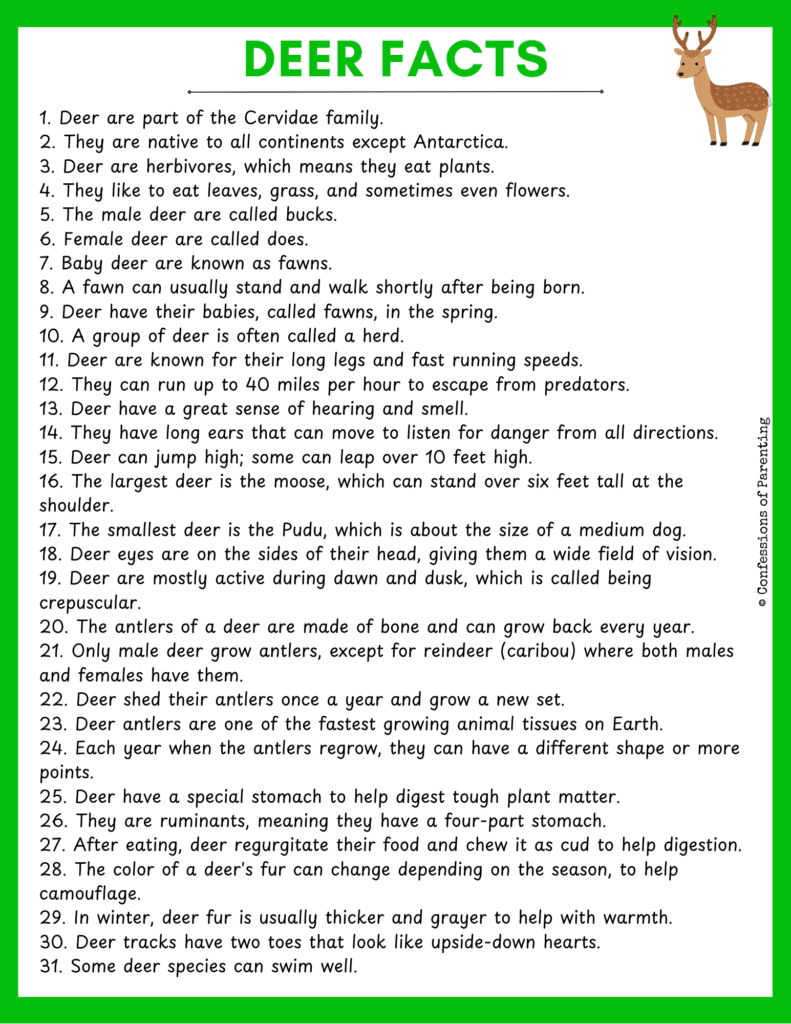
Deer Facts
Let’s pounce on these amazing deer facts that will make you the expert on one of the wildest animals in the jungle!

- Deer are part of the Cervidae family.
- They are native to all continents except Antarctica.
- Deer are herbivores, which means they eat plants.
- They like to eat leaves, grass, and sometimes even flowers.
- The male deer are called bucks.
- Female deer are called does.
- Baby deer are known as fawns.
- A fawn can usually stand and walk shortly after being born.
- Deer have their babies, called fawns, in the spring.
- A group of deer is often called a herd.
- Deer are known for their long legs and fast running speeds.
- They can run up to 40 miles per hour to escape from predators.
- Deer have a great sense of hearing and smell.
- They have long ears that can move to listen for danger from all directions.
- Deer can jump high; some can leap over 10 feet high.
- The largest deer is the moose, which can stand over six feet tall at the shoulder.
- The smallest deer is the Pudu, which is about the size of a medium dog.
- Deer eyes are on the sides of their head, giving them a wide field of vision.
- Deer are mostly active during dawn and dusk, which is called being crepuscular.
- The antlers of a deer are made of bone and can grow back every year.
- Only male deer grow antlers, except for reindeer (caribou) where both males and females have them.
- Deer shed their antlers once a year and grow a new set.
- Deer antlers are one of the fastest growing animal tissues on Earth.
- Each year when the antlers regrow, they can have a different shape or more points.
- Deer have a special stomach to help digest tough plant matter.
- They are ruminants, meaning they have a four-part stomach.
- After eating, deer regurgitate their food and chew it as cud to help digestion.
- The color of a deer’s fur can change depending on the season, to help camouflage.
- In winter, deer fur is usually thicker and grayer to help with warmth.
- Deer tracks have two toes that look like upside-down hearts.
- Some deer species can swim well.
- Deer often use well-trodden paths called trails to move around.
- White-tailed deer are named for their white tail underside, which they flash when alarmed.
- The mule deer has large mule-like ears that move independently.
- When sensing danger, deer will often freeze and listen before they run.
- Deer communicate using sounds, body language, and scent marking.
- They can make various noises such as grunts, whistles, and snorts.
- Deer have glands near their eyes and on their feet for scent marking.
- The lifespan of a deer in the wild is usually around 10 years, though some can live longer.
- Predators of deer include wolves, bears, mountain lions, and humans.
- Deer populations are controlled by hunting and natural predators.
- Deer are celebrated in various cultures and are often featured in art and folklore.
- Venison is the term for meat from deer and is eaten in many parts of the world.
- The deer population in North America was once very low but has recovered due to conservation efforts.
- Deer are good jumpers and swimmers, which helps them avoid predators.
- Some deer, like the reindeer, migrate long distances to find food.
- Reindeer have been domesticated in some Arctic and Subarctic regions.
- Deer need to drink water daily but can also get moisture from the plants they eat.
- Their hooves are split into two, which helps them walk through soft ground like mud or snow.
- Deer have a special coat with hollow hairs that help keep them warm.
- The spots on a fawn help it hide by mimicking the pattern of sunlight on the forest floor.
- Most fawns lose their spots as they grow up and get a more uniform coat color.
- Deer often rest in dense brush or tall grass for camouflage.
- Some species of deer are endangered due to habitat loss and overhunting.
- Conservation areas and laws help protect deer populations.
- Deer play a crucial role in their ecosystem by helping to control vegetation.
- Overpopulation of deer can lead to issues like crop damage and forest overgrazing.
- Deer are sometimes involved in car accidents, especially during mating season when they move more.
- Many places have specific seasons when people can legally hunt deer.
- Deer hunting is a tradition and important for managing wildlife populations in many areas.
- Deer have a “flight zone,” a distance they keep from predators or threats. If you enter this zone, they will likely flee.
- The gestation period for a doe is about 6.5 months, or 200 days.
- Does can give birth to one to three fawns, usually two.
- Young deer are very vulnerable to predators, so does hide them in tall grass or bushes.
- Fawns have a unique scent that helps does recognize their own.
- A deer’s lifespan in captivity can be much longer than in the wild, sometimes up to 20 years.
- Some deer, like the white-tailed deer, are known for their “flagging” or raising their tails to warn other deer of danger.
- The Chinese water deer has tusks instead of antlers, which it uses to fight and defend itself.
- Deer are a symbol of grace and beauty in many cultures.
- Various species of deer have different antler shapes, which can help identify them.
- The Sambar deer from Asia has antlers that can grow up to 40 inches long.
- Deer often sleep with their noses tucked into their hind legs to keep warm.
- Deer are able to make quick and sharp turns while running to escape predators.
- Deer have a strong survival instinct and are highly adaptable to different environments.
- The roe deer is one of the smallest species in Europe and changes its coat color from red in the summer to grey in the winter.
- Deer are crepuscular, meaning their activity peaks at dawn and dusk.
- Some deer species bark as an alarm call when they detect danger.
- Deer are part of many national symbols and park emblems around the world.
- The elk, or wapiti, is one of the largest species of deer in the world.
- In many species of deer, the females are in charge of caring for the young.
- The fallow deer has a unique antler shape that looks like a shovel.
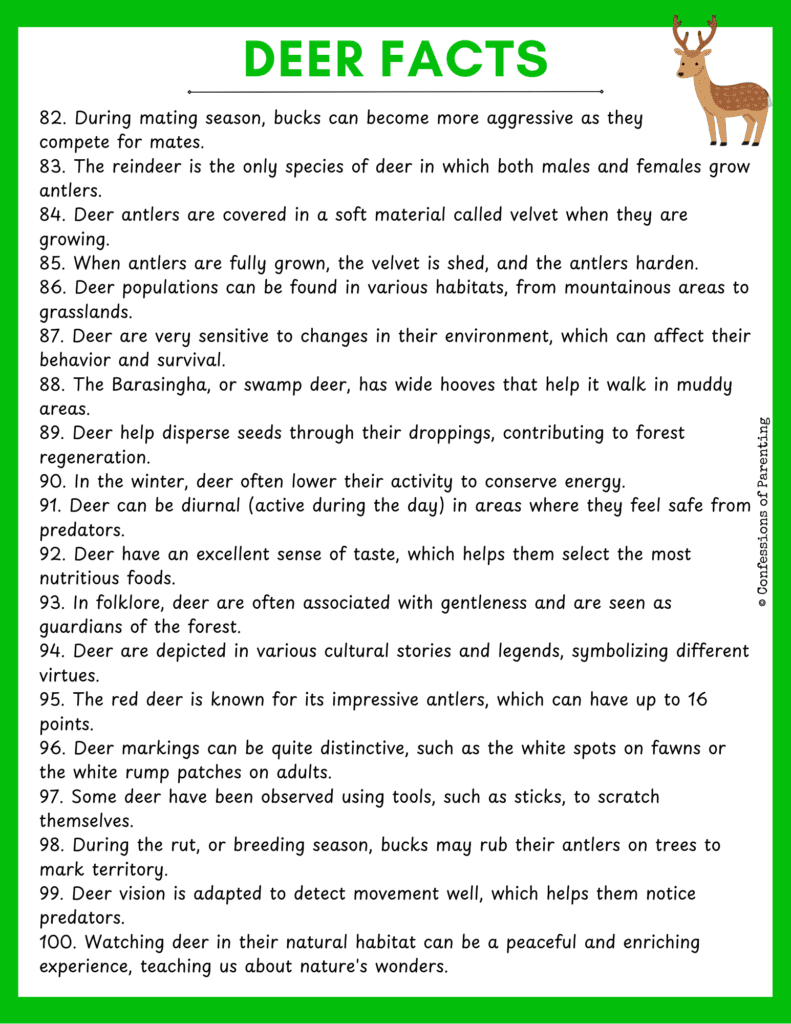
- During mating season, bucks can become more aggressive as they compete for mates.
- The reindeer is the only species of deer in which both males and females grow antlers.
- Deer antlers are covered in a soft material called velvet when they are growing.
- When antlers are fully grown, the velvet is shed, and the antlers harden.
- Deer populations can be found in various habitats, from mountainous areas to grasslands.
- Deer are very sensitive to changes in their environment, which can affect their behavior and survival.
- The Barasingha, or swamp deer, has wide hooves that help it walk in muddy areas.
- Deer help disperse seeds through their droppings, contributing to forest regeneration.
- In the winter, deer often lower their activity to conserve energy.
- Deer can be diurnal (active during the day) in areas where they feel safe from predators.
- Deer have an excellent sense of taste, which helps them select the most nutritious foods.
- In folklore, deer are often associated with gentleness and are seen as guardians of the forest.
- Deer are depicted in various cultural stories and legends, symbolizing different virtues.
- The red deer is known for its impressive antlers, which can have up to 16 points.
- Deer markings can be quite distinctive, such as the white spots on fawns or the white rump patches on adults.
- Some deer have been observed using tools, such as sticks, to scratch themselves.
- During the rut, or breeding season, bucks may rub their antlers on trees to mark territory.
- Deer vision is adapted to detect movement well, which helps them notice predators.
- Watching deer in their natural habitat can be a peaceful and enriching experience, teaching us about nature’s wonders.
Deer Trivia for Kids
Ready to test out your deer fact knowledge? See how many deer trivia questions you can get right!

- Q: What do deer like to eat?
A: Leaves, grass, and sometimes flowers. - Q: What is a male deer called?
A: A buck. - Q: What is a female deer called?
A: A doe. - Q: What is a baby deer called?
A: A fawn. - Q: What do we call a group of deer?
A: A herd. - Q: When are deer most active?
A: Dawn and dusk. - Q: What can only male deer grow?
A: Antlers. - Q: Which deer is the largest?
A: The moose. - Q: Which deer is the smallest?
A: The Pudu. - Q: What special ability do deer have with their ears?
A: They can move them to listen for danger from all directions. - Q: How fast can deer run?
A: Up to 40 miles per hour. - Q: Why do fawns have spots?
A: To help them hide by mimicking the pattern of sunlight on the forest floor. - Q: What are deer’s hooves like?
A: They are split into two. - Q: What is the term for deer meat?
A: Venison. - Q: Can deer swim?
A: Yes, some deer can swim well. - Q: How do deer communicate danger?
A: By flashing their white tail underside. - Q: What kind of stomach do deer have?
A: A four-part stomach. - Q: Do both male and female reindeer grow antlers?
A: Yes, both males and females. - Q: What do deer do after eating to help digestion?
A: Regurgitate their food and chew it as cud. - Q: How high can deer jump?
A: Over 10 feet high. - Q: How do deer sleep to keep warm?
A: With their noses tucked into their hind legs. - Q: What is unique about the Chinese water deer’s teeth?
A: It has tusks instead of antlers. - Q: What color change happens to deer fur in the winter?
A: It becomes thicker and grayer. - Q: What type of deer has large mule-like ears?
A: The mule deer. - Q: What helps deer walk through soft ground like mud or snow?
A: Their split hooves. - Q: What do deer use their antlers for besides mating displays?
A: To fight and defend themselves. - Q: How do deer mark their territory?
A: By using scent from glands near their eyes and on their feet. - Q: When do deer shed their antlers?
A: Once a year. - Q: What are deer antlers made of?
A: Bone. - Q: What animal is a predator of deer?
A: Wolves, bears, and mountain lions. - Q: What time of year do does have their fawns?
A: In the spring. - Q: How long can deer live in the wild?
A: Usually around 10 years. - Q: What does crepuscular mean?
A: Active during dawn and dusk. - Q: What helps deer keep warm in the winter?
A: Their thick, hollow-haired coat. - Q: What is the gestation period for a doe?
A: About 6.5 months or 200 days. - Q: How many fawns can a doe give birth to at one time?
A: One to three fawns. - Q: What helps fawns hide from predators?
A: Their spots. - Q: What special part of their body helps deer detect predators?
A: Their large ears. - Q: Why do deer need to drink water daily?
A: To stay hydrated and help with food digestion. - Q: What is a unique feature of reindeer?
A: Both males and females grow antlers. - Q: What do deer trails help them do?
A: Move around their habitat easily. - Q: What are the special hairs on a deer called that help them stay warm?
A: Hollow hairs. - Q: Why do deer have a wide field of vision?
A: Because their eyes are on the sides of their head. - Q: What is unique about deer tracks?
A: They look like upside-down hearts. - Q: How can deer quickly escape predators?
A: By making quick and sharp turns while running. - Q: What type of coat do deer have in winter?
A: A thicker and grayer coat than in summer. - Q: Why do deer lower their activity in the winter?
A: To conserve energy. - Q: What helps deer choose nutritious foods?
A: Their excellent sense of taste. - Q: What do deer do during the rut or breeding season?
A: Bucks may rub their antlers on trees to mark territory. - Q: What can overpopulation of deer lead to?
A: Issues like crop damage and forest overgrazing.

Hard Deer Trivia
Want some hard deer trivia questions? See if you can answer these questions!
- Q: What specific family do deer belong to?
A: Cervidae. - Q: Name a continent where deer are not native.
A: Antarctica. - Q: What type of animal is a deer in terms of its diet?
A: Herbivore. - Q: What is the term used to describe deer activity during dawn and dusk?
A: Crepuscular. - Q: Which species of deer is known for migrating long distances?
A: Reindeer (caribou). - Q: What material are deer antlers made of?
A: Bone. - Q: How do deer help in seed dispersal?
A: Through their droppings. - Q: What unique type of stomach do deer have?
A: A four-chambered ruminant stomach. - Q: How do deer communicate with each other?
A: Using sounds, body language, and scent marking. - Q: Which deer species has the largest antlers in proportion to its body size?
A: The Irish Elk, an extinct species. - Q: What is the unique feature of the Pudu deer?
A: It is the smallest deer species. - Q: Which deer species is known for its large mule-like ears?
A: The mule deer. - Q: What purpose do the spots on a fawn serve?
A: Camouflage. - Q: During what season do deer usually shed their antlers?
A: Late winter to early spring. - Q: What physiological feature allows deer to have a wide field of vision?
A: Eyes positioned on the sides of their head. - Q: What is the primary reason deer antlers grow?
A: For mating purposes and to establish dominance. - Q: Name the substance that covers growing antlers.
A: Velvet. - Q: Which deer can have tusks instead of antlers?
A: The Chinese water deer. - Q: What is the main threat to deer populations globally?
A: Habitat loss and hunting. - Q: Which deer species has been successfully domesticated in some regions?
A: Reindeer. - Q: What is a unique defensive behavior deer may display when threatened?
A: Stotting or pronking, which is a high, stiff-legged jump. - Q: What is the main predator of deer in North America?
A: The wolf. - Q: What is a major consequence of deer overpopulation?
A: Environmental degradation and increased vehicle collisions. - Q: How do fawns avoid being detected by predators in the wild?
A: By remaining still and silent, with little to no scent. - Q: What change occurs in deer fur from summer to winter?
A: It becomes thicker and often changes color to blend in with the snowy environment. - Q: What is the gestation period for a typical deer species like the white-tailed deer?
A: Approximately 200 days. - Q: How do deer adapt their diet in the winter when vegetation is scarce?
A: They browse more on woody plants and bark. - Q: What unique adaptation do deer have for digesting tough cellulose in plants?
A: A specialized stomach with bacteria that break down cellulose. - Q: Which part of a deer’s body is involved in scent marking?
A: Glands near the eyes and on the feet. - Q: What impact does deer rubbing have on trees?
A: It can damage young trees and affect forest composition. - Q: What are some methods used by wildlife managers to control deer populations?
A: Hunting regulations, reintroduction of predators, and contraceptive vaccines. - Q: What natural event can significantly affect deer survival rates?
A: Harsh winters with heavy snowfall. - Q: How does the social structure of deer affect their survival?
A: Social hierarchies can determine access to food and mates, impacting overall health. - Q: Why do deer need to drink water daily despite getting moisture from their food?
A: To aid digestion and maintain hydration, especially in hot weather or during lactation. - Q: Which deer species has adapted to urban environments?
A: The white-tailed deer. - Q: What is the role of antlers in deer fights?
A: They are used to push against opponents and establish dominance without serious injury. - Q: How can you tell the age of a deer?
A: By examining the wear and formation of their teeth. - Q: What is the purpose of a deer’s tail communication?
A: To signal danger or communicate social information to other deer. - Q: Which deer species is known for its endurance in cold climates?
A: The caribou (reindeer). - Q: What unique feature distinguishes the fallow deer from others?
A: Its shovel-shaped antlers. - Q: How does the body size of deer influence their predator evasion strategies?
A: Larger deer may rely more on fighting or slower, more powerful running, while smaller deer rely on agility and quick escapes. - Q: What ecological role do deer play in their habitats?
A: As herbivores, they help shape vegetation structures and influence other animal populations. - Q: How does the presence of wolves affect deer behavior?
A: Deer may change their movement patterns, become more vigilant, and alter feeding locations and times. - Q: What are the consequences of removing large predators like wolves from deer habitats?
A: Potential overpopulation of deer and associated ecological impacts such as overgrazing. - Q: How do deer avoid inbreeding in dense populations?
A: By dispersing young, especially males, to new areas. - Q: What genetic diversity issues can affect deer populations?
A: Low genetic diversity can increase disease susceptibility and reduce adaptability. - Q: How have deer adapted to evade human hunters?
A: By becoming more nocturnal in heavily hunted areas. - Q: What role does memory play in deer survival?
A: Deer remember safe feeding sites, escape routes, and seasonal migration paths. - Q: What are some ways that deer have impacted human activities?
A: Causing vehicle accidents, affecting agricultural practices, and influencing forest management policies. - Q: What measures can be taken to mitigate deer-related vehicle accidents?
A: Installing wildlife crossings, setting up road signs, and managing vegetation near roads.

What fascinating deer facts did you learn that you didn’t know? How many of the deer trivia questions did you answer correctly? Keep exploring the world around you, and who knows what amazing facts you’ll uncover next.

Michele Tripple is a renowned author and expert in the fields of parenting, relationships, and personal development. She is a certified Life Coach with her degree in marriage and family studies, her experience as a Family Life Educator, and over a decade of experience as a professional writer; Michele has authored books that provide practical advice and insights into improving family dynamics and personal growth. Her work is celebrated for its blend of research-driven information and relatable, real-world applications. Michele has been a keynote speaker at conferences and has contributed to numerous publications and media outlets, solidifying her reputation as an authoritative voice in her field and helping families build relationships.